
Emergency Air Duct Cleaning Near Me: What Norman Homeowners Should Do First
If you’ve just found standing water near a return air boot or spotted rodent droppings inside a supply trunk, your instinct to call for emergency duct cleaning is right. But the twenty minutes before anyone arrives matter more than most homeowners realize. The wrong move in that window, like running the system to “see if it clears out,” can push contamination into every branch line in the house. Here’s what to do first.
If you’d rather not sort through it alone, call (866) 493-6592. We answer 24/7. Fast dispatch from 7am to 7pm, Sunday through Friday.
Key Takeaways
- Shut off the air handler the moment you suspect water, rodent or debris intrusion in the ducts.
- Figure out whether the problem is in the ductwork or in the air handler and coil section – it changes who you should call first.
- Take photos before anything is touched. They help your insurer and give the technician an accurate scope on arrival.
- Tell the dispatcher exactly what you found. Water and rodent events call for different equipment than routine cleaning.
Why Is Shutting Off Your Air Handler the First Step?
Turn the system off at the thermostat and, if you can reach it safely, at the breaker that feeds the air handler. This is the single most important thing you can do in the first few minutes of a water intrusion event. A running system pulls air through wet insulation, damp duct board and standing water, then distributes that moisture-laden air into every room in the house. You’re essentially giving mold spores a free ride through the whole system.
In our experience, the homes that come through a water event with the least damage are the ones where someone killed power immediately. The ones that fume for hours before calling tend to have contamination spread well beyond the original wet spot.
A few things to keep in mind while the system is off:
- Don’t run the fan in “on” mode to dry things out. That circulates moisture, it doesn’t remove it.
- Don’t tape over registers and call it containment – that traps humidity inside the ductwork.
- Don’t spray household cleaners or bleach into a register. You can’t reach the contamination this way, and you can damage the duct lining.
- If there’s standing water near the air handler, kill power to that unit first, then mop up what you can reach safely.
Air handlers, coils and the electrical components around them are not a place to go poking. If water is anywhere near wiring or the blower compartment, leave it alone and let a trained technician handle it. That’s a genuine safety line, not a liability disclaimer.
Is the Problem in the Ducts or the Air Handler?
This is the question that determines who you should call first, and most homeowners skip it. Contamination that lives in the ductwork – debris, dust, rodent evidence, debris pulled in through an exterior termination – is a duct cleaning problem. Contamination that lives in the air handler, the evaporator coil or the drain pan is an HVAC service problem, and often a moisture problem underneath it.
Here’s a quick way to tell the difference:
- Look at the registers. Debris, dust streaks or droppings at multiple supply registers usually point to the duct system itself.
- Check the return grille. Heavy buildup on the return side, especially near the air handler, often means the contamination is concentrated close to the equipment.
- Look at the air handler and coil. Standing water in the drain pan, a wet cabinet, visible biological growth on the coil or cabinet interior – that’s HVAC territory first, then duct cleaning once the moisture source is fixed.
- Smell the air. A musty smell that’s strongest right at the return usually points to the air handler. A smell that’s strongest in specific rooms points to the branch lines serving those rooms.
If you’re not sure, that’s fine. Tell the dispatcher what you saw and where. That single detail is what determines whether a standard cleaning team or a remediation-equipped team shows up. It’s also the difference between fixing the problem once and cleaning ducts that get recontaminated within weeks because the moisture source was never addressed.
Why Norman’s Spring Storms Push Debris Into Ductwork
Norman sits right in the middle of the most active severe weather corridor in the country, and spring storm season does more to ductwork than most homeowners expect. High winds drive debris, insulation fragments and roof grit against exterior terminations. Loose or damaged termination caps let that material work its way inside. In smaller homes and older builds, exterior terminations near grade or under porches are the usual entry points for mice and other small animals looking for shelter during a storm.
Wet insulation from a roof leak or a storm-driven water intrusion is the other piece. Once duct insulation gets wet, it stays wet, and it becomes a growth medium that no amount of cleaning will fix without replacing the affected section. What we typically see in Norman homes after a storm event:
- Debris packed against the outdoor termination screen or cap
- Loose flex duct connections at the air handler or in the attic where wind-driven vibration has worked them apart
- Moisture in duct runs that pass through unconditioned attic space
- Animal evidence – droppings, nesting material or entry holes – at exterior penetrations
If your home is in Norman and you’ve had a storm event in the last few weeks, it’s worth a look at the exterior terminations and any duct runs in the attic before the next system moves through.
What Should You Photograph Before Anyone Arrives?
Take photos before you touch anything. This is the step homeowners most often skip, and it’s the one that helps both your insurer and the technician. Photos serve two purposes: they document the loss for an insurance claim, and they let the technician scope the job accurately before they arrive rather than guessing at arrival.
Capture these before cleanup:
- Affected registers. Close-up shots of any register with visible debris, dust streaks or moisture, plus a wider shot showing where it sits in the room.
- Water line marks. Photograph the waterline on duct board, insulation, drywall or the air handler cabinet. Once it dries, that line is the only record of how high the water reached.
- Animal entry points. Photograph the holes, gaps or damaged terminations, plus any droppings or nesting material. Don’t clean it up first – that’s evidence.
- The air handler and drain pan. A clear shot of the cabinet interior and the pan, especially if water or growth is visible.
- Exterior terminations. Photograph every vent cap and screen on the outside of the house, whether or not it looks damaged.
Save the photos with a date stamp if your phone does that automatically. Your insurer will want a timeline, and the technician will use them to figure out equipment class before the visit. It’s not glamorous work, but it beats describing the problem from memory while a technician stands in your hallway trying to picture it.
What Should You Tell the Dispatcher?
The dispatcher needs to know three things, in this order: what you found, where you found it, and when it started. That’s it. The rest can be sorted out on arrival. But those three answers determine which team and which equipment show up, and that matters when the contamination involves water or rodents rather than ordinary dust.
- What you found. “Standing water near the return air boot” is a different call than “rodent droppings in a supply trunk” or “debris packed against the outdoor vent cap.” Say it plainly.
- Where. Which register, room or part of the system. “Near the air handler in the garage” is enough detail to start.
- When it started. Storm damage last week? A slow leak you just noticed? That timeline tells the technician how much moisture has had time to spread.
While you’re at it, mention whether the system is currently off, and whether you’ve seen any animal activity or smell. If the answer involves water or rodents, the team needs remediation-grade equipment – containment, negative air and HEPA filtration – rather than a standard cleaning setup. That’s the equipment class question that competitive quotes skip, and it’s the one that determines whether the job actually gets done right.
When to Call a Pro
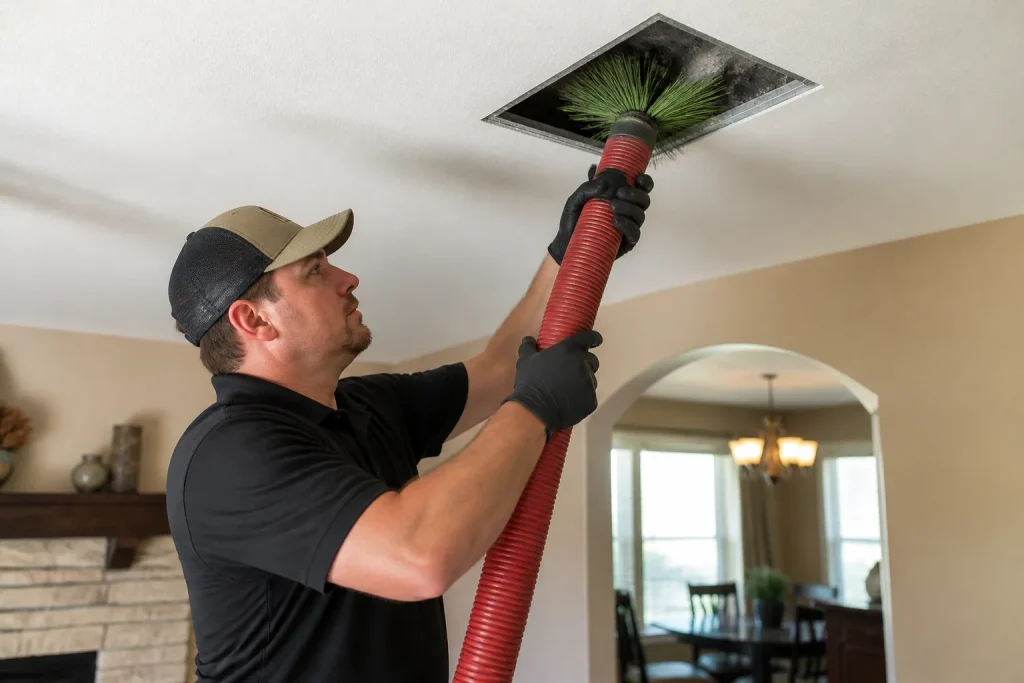
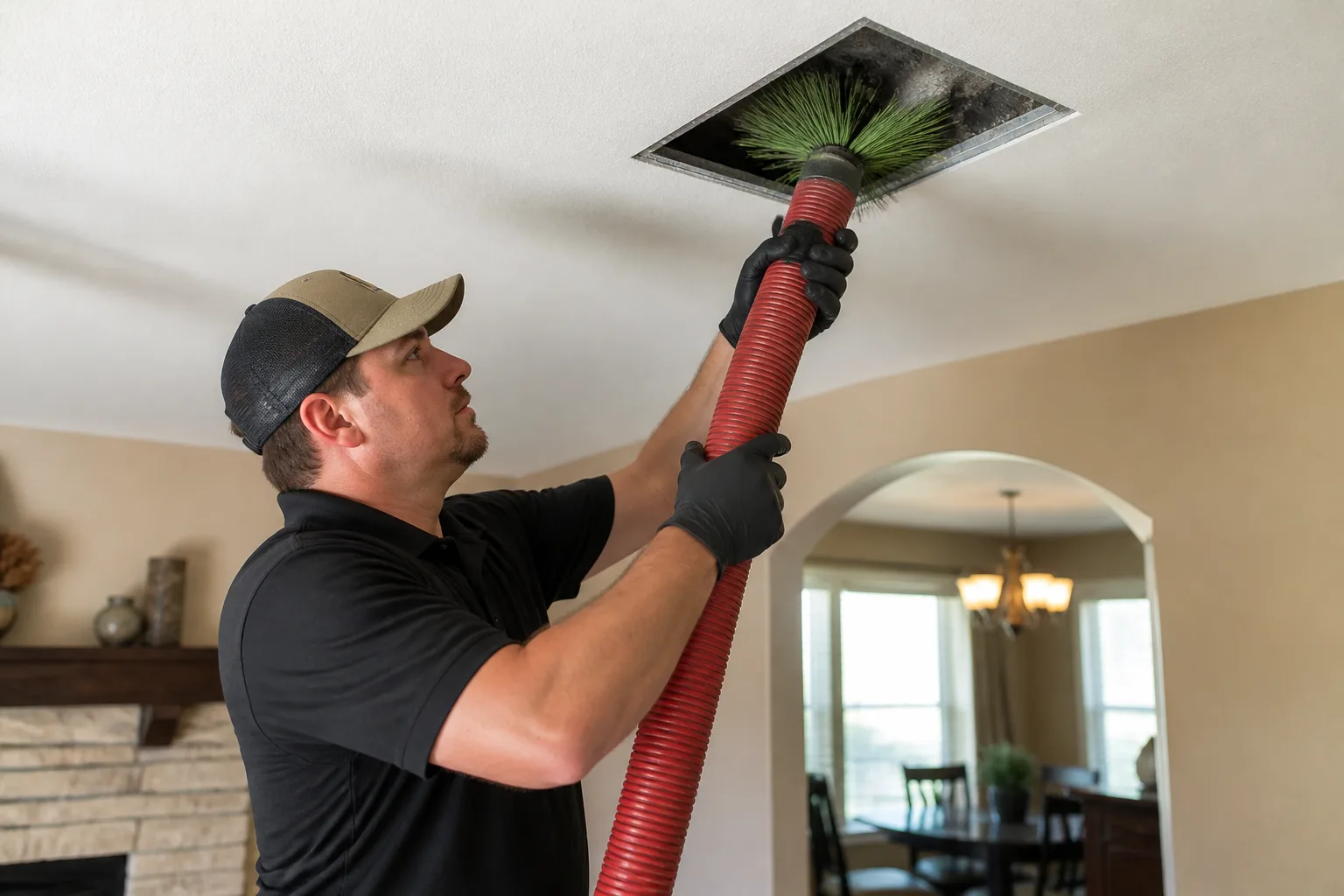
If the contamination involves water, rodents, or visible growth anywhere in the system, this isn’t a shop-vac job. Call us and describe what you found. We bring Rotobrush contact-cleaning systems, Nikro negative-air and HEPA equipment, and Abatement Technologies filtration gear, so the containment side of the job is handled properly from the start. If your air handler or coil is the source, we’ll tell you, and we’ll point you toward HVAC service before we touch the ducts.
Related services in Norman
Once the emergency is contained, the next step usually involves air duct cleaning to clear the system properly, and sometimes dryer vent cleaning if you’re already having the whole system looked at. If a duct run was damaged in the storm, our air duct repair service handles that without a second contractor.
To understand what we do across the board, see Duct Cleaning Norman, and for local context on the area we serve, visit our Norman page.
The Bottom Line
The first twenty minutes after a duct emergency are about containment, not cleaning. Shut the system off, identify whether the problem is in the ductwork or in the air handler, photograph everything before you touch it, and tell the dispatcher exactly what you found. Those four steps protect your home from spread, protect your insurance claim and protect the next technician’s time. Our technicians have up to 13 years of experience and know the difference between a routine cleaning and a contamination event that needs remediation-grade equipment.
If you’re in Norman and need help, Duct Cleaning Norman offers free estimates. Call (866) 493-6592. We answer 24/7. Fast dispatch from 7am to 7pm, Sunday through Friday.
Frequently Asked Questions
Most whole-system cleanings fall in a typical range of $350 to $700 depending on the size of the home, the number of register runs and what’s actually found in the system. Jobs involving water intrusion or rodent contamination can run higher because they require containment and remediation-grade filtration, not just a standard cleaning pass. The written estimate you receive before work starts sets the final price. Call (866) 493-6592 for an exact quote – estimates are free.
Low advertised prices usually cover a partial pass through the system, not a full cleaning with proper containment. What they leave out is the equipment class that determines whether debris is actually captured or just stirred into the air: HEPA filtration, negative-air containment, and contact cleaning that agitates and vacuums every run. If the quote doesn’t name the equipment and doesn’t include before-and-after photos, that’s the gap you’re paying for later. Call (866) 493-6592 to talk through what a full scope actually involves.
We show before-and-after photos of your own ducts, register by register. You’ll see exactly what came out and exactly what condition each run is in. That’s the documentation standard we work to, and it’s what you should expect from anyone doing this work in your home. Call (866) 493-6592 to schedule and see what the process looks like in your Norman home.
Most Norman homes do fine with cleaning every three to five years, but specific events reset the clock: a water intrusion, a rodent problem, a major renovation, or storm damage to the exterior terminations. Any of those make it worth an inspection regardless of when the last cleaning happened. If you’re unsure, a quick look at the return grille and the registers will tell you more than the calendar will. Call (866) 493-6592 and we’ll walk through what your system needs.
Written by the team at Duct Cleaning Norman.
Need Air Duct Cleaning Help?
Call Duct Cleaning Norman - licensed & insured, with free written estimates in Norman.
(866) 493-6592